A Technical Guide to Seamless Compliance Integration In today’s digital ecosystem, compliance systems cannot operate in isolation. Organizations rely on multiple platforms—CRMs, ERPs, trading systems, HR tools, and payment gateways. Without integration, compliance becomes fragmented, manual, and error-prone. WaliComply360 is built with integration at its core—designed to plug into your existing technology stack without disruption. Why Integration Matters in Compliance
A disconnected compliance system leads to: • Duplicate data entry • Inconsistent client records • Delayed risk detection • Inefficient reporting • Increased audit risk
Integration ensures that compliance becomes embedded into your operations, not an afterthought. WaliComply360 Integration Philosophy
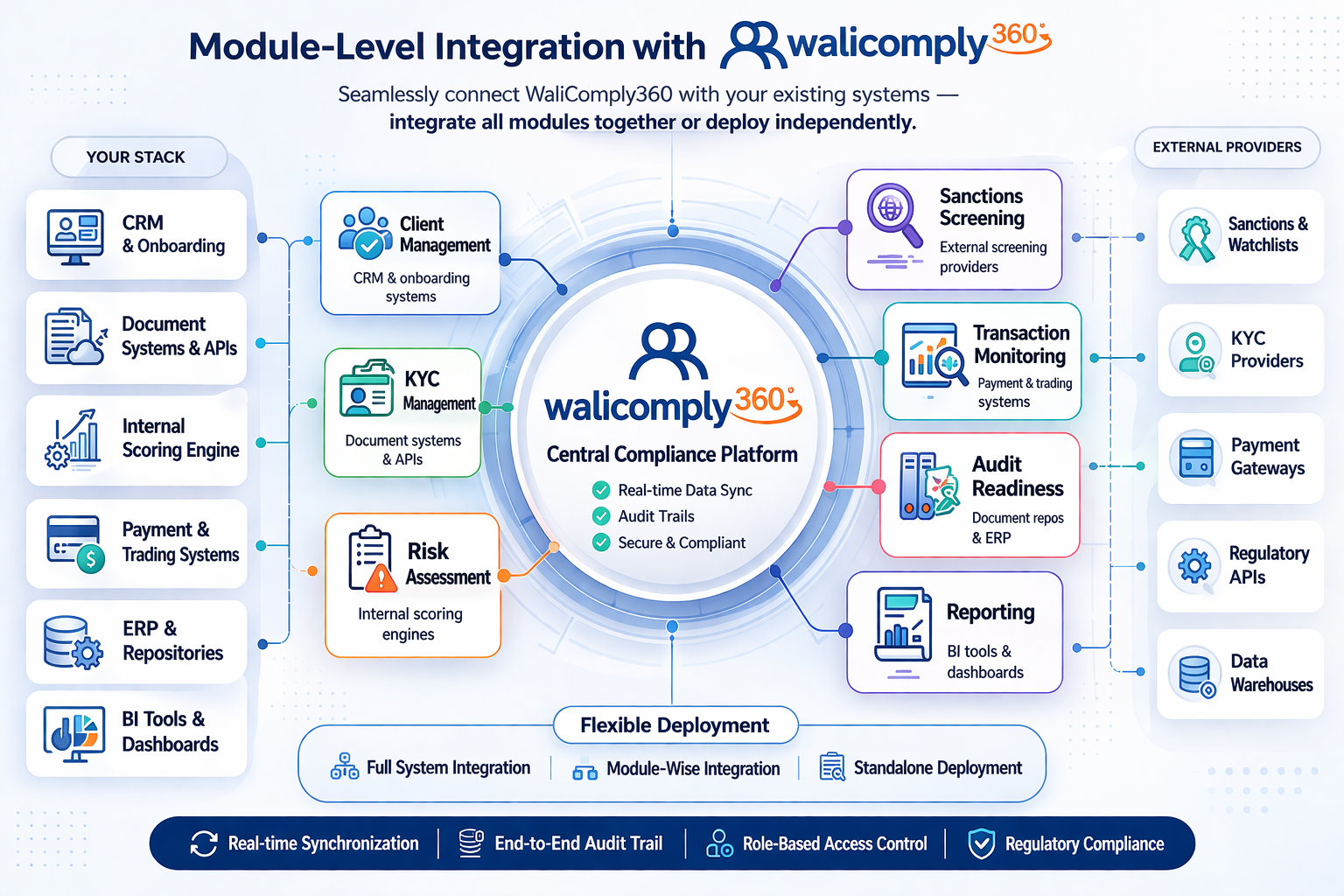
WaliComply360 follows a modular and API-first architecture, allowing: • Full system deployment (end-to-end compliance ecosystem) • Partial integration (specific modules only) • Seamless data exchange across systems
This flexibility ensures that businesses of all sizes—from Category 1 brokers to real estate firms and DPMS entities—can integrate without overhauling their infrastructure. Key Integration Points
1. CRM Integration (Client Lifecycle Synchronization) Integrate WaliComply360 with your CRM to enable:
• Automatic client onboarding sync • Real-time KYC data updates • Unified client profiles across systems • Elimination of duplicate records
Example: A client added in your CRM is automatically pushed to WaliComply360, where KYC, risk scoring, and screening begin instantly.
2. KYC & Document Management Systems WaliComply360 integrates with document repositories to:
• Fetch and store client documents • Enable real-time KYC validation • Track document expiry and renewals This ensures centralized and regulator-ready document management.
3. Payment Gateways & Transaction Systems For financial institutions and DNFBPs:
• Transaction data flows into the Transaction Monitoring Module • Real-time red flags are triggered • Suspicious activity is identified instantly
This allows proactive AML/CFT compliance aligned with regulatory expectations. 4. Sanctions & External Data Providers WaliComply360 supports integration with:
• Global sanctions databases
• PEP and adverse media providers • Local UAE regulatory lists
This ensures real-time, automated screening with minimal manual intervention. 5. ERP & Financial Systems Integration with ERP systems enables:
• Financial data synchronization • Audit-ready financial reporting • Alignment with regulatory submission requirements
This is critical for Category 1 brokers and regulated financial entities.
6. HR & Internal Systems For internal compliance:
• Employee screening integration • Training log synchronization • Role-based access control This supports governance, internal audit, and regulatory inspections.
Module-Level Integration Flexibility WaliComply360 allows granular integration at module level:
Module Integration Capability
Client Management CRM & onboarding systems
KYC Management Document systems & APIs
Risk Assessment Internal scoring engines
Sanctions Screening External screening providers
Transaction Monitoring Payment & trading systems
Audit Readiness Document repositories & ERP
Reporting BI tools & dashboards
You can integrate all modules together or deploy them independently based on your business model. Data Flow Architecture (Simplified)
Inbound Data: • Client data from CRM • Transactions from payment systems • Documents from KYC tools
Processing Layer (WaliComply360): • Risk scoring • Sanctions screening • Transaction monitoring • Compliance workflows
Outbound Data: • Alerts and notifications • Reports for management and regulators • STR/goAML submission records
Security & Compliance Considerations Integration is not just about connectivity—it’s about secure and compliant data handling.
WaliComply360 ensures: • Role-based access control (RBAC) • Full audit logs for every action • Data encryption and secure storage • Compliance with UAE AML/CFT regulations
This guarantees that your integrated environment remains secure, auditable, and regulator-ready. Benefits of Integration
1. Operational Efficiency No duplicate work—data flows automatically across systems.
2. Real-Time Compliance Immediate detection of risks and suspicious activities.
3. Audit Readiness All records are synchronized and centrally available.
4. Scalability Easily adapt as your business and regulatory requirements grow.
5. Cost Optimization Reduce manual processes and operational overhead. Use Case: End-to-End Integrated Workflow:
1. Client onboarded via CRM 2. Data pushed to WaliComply360 3. KYC verification initiated 4. Risk score assigned 5. Sanctions screening performed 6. Transactions monitored in real-time 7. Alerts generated (if any) 8. Reports compiled automatically 9. Audit records stored and accessible
Result: A fully automated, compliant, and audit-ready ecosystem
Final Thoughts: In a regulatory environment where speed, accuracy, and transparency are critical, integration is no longer optional. WaliComply360 transforms compliance from a siloed function into a fully integrated, intelligent system—working seamlessly within your existing stack. Whether you choose a full deployment or modular integration, the outcome is the same:
✔ Streamlined operations ✔ Reduced compliance risk ✔ Continuous audit readiness